First murder mystery
Published September 1, 2024
Last year (in fact so long ago that I’d forgotten I’d ordered this and it was a surprise present in the post), I bought The Researcher’s First Murder by John Finnemore. This was one of those purchases that was really to support the creator more than for my pleasure, because a) I love JF and b) this thing is far too smart for me, but wahey, it has arrived and it’s beautiful!
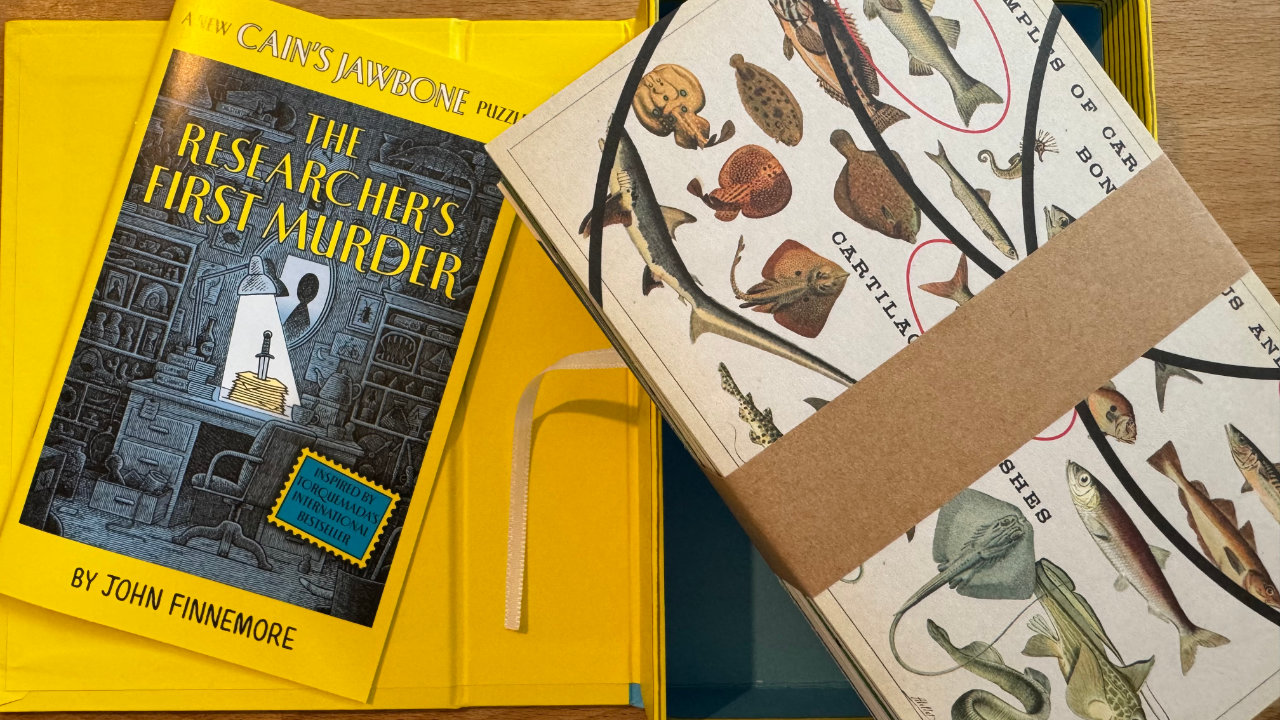
As a bit of background, it’s a follow up to the puzzle work Cain’s Jawbone, which is a fiendishly difficult project from the 1930s that very few people have solved. There are muddled up pages and puzzles and you have to put it all in the right order based on the clues to solve the mystery. This new version is the same idea but updated for a modern audience, the man himself explains:
This time, solvers will receive a box of one hundred picture postcards. As with Cain’s Jawbone, they will need to arrange the text sides in the correct order, and understand the story told there, in order to identify the killer and victim in a series of ten murders; as well as a certain crucial address. But in order to do this, they will also need to solve the various puzzles presented by the picture sides.
The picture side puzzles allow me to do two things: firstly, compensate for the arrival of the internet since 1934. You may now be able to google an obscure Walt Whitman quotation, but you can’t google ‘How on earth is this picture of a tree a puzzle?’ Secondly, if Cain’s Jawbone had a flaw (which I don’t admit) it’s that it’s a little off-putting and seemingly impenetrable until you make a certain breakthrough. I think a lot of people had a brief look through the cards, thought ‘Well, that’s impossible’ and gave up. I certainly did, before lockdown came along and invited me to have another go. So the picture puzzles - which are also, to be clear, ridiculously difficult - give the solver something they can immediately get their teeth into, while they’re grappling with the madness on the other side.
If I’m being honest, the words side appeals to me more than the other, but it all looks superbly difficult. I may play around with these cards and give it a go but I have zero expectations of getting anywhere other than looking at them and admiring the production and artwork.
Still, I highly recommend grabbing a copy because if you are smarter than me and can give this a proper go, I know it will be worth it. John Finnemore’s work always is.