Rifleman by Victor Gregg
Published August 19, 2013
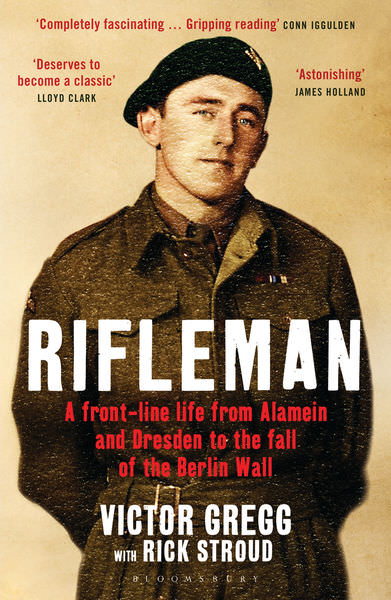
Book info
- Title Rifleman
- Author Victor Gregg
- Year 2011
- Genre Memoir
Born into a working-class family in London in 1919, Victor Gregg enlisted in the Rifle Brigade at nineteen, was sent to the Middle East and saw action in Palestine. Following service in the western desert and at the battle of Alamein, he joined the Parachute Regiment and in September 1944 found himself at the battle of Arnhem. When the paratroopers were forced to withdraw, Gregg was captured. He attempted to escape, but was caught and became a prisoner of war; sentenced to death in Dresden for attempting to escape and burning down a factory, only the allies' infamous raid on the city the night before his execution saved his life. Gregg's fascinating story, told in a voice that is good-natured and completely original, continues after the end of the war. In the fifties he became chauffeur to the Chairman of the Moscow Norodny bank in London, involved in shady dealings and strange meetings with MI5, MI6 and the KGB. His adventures, though, were not over - in 1989, on one of his many motorbike expeditions into Eastern Europe, he found himself at a rally of 700 people in a field in Sopron at a fence that formed part of the barrier between the Soviet Union and the West. Vic cut the wire, and a few weeks later the Berlin Wall itself was destroyed - a truly unexpected coda to an incredible life lived to the full. This is the story of a true survivor.
Thoughts
At first, I wasn’t sure what to expect from this book. The introduction gives away a lot of what Victor has done during his life, and I was worried it was going to be an improbable mass of incidents, talked up to seem interesting. It was nothing like that. The book focuses on the army years of Victor’s life for the first two thirds, and then the final third is what happened to him afterwards.
We’re taken on the journey with the Rifles brigade, where at first it seems like great japes and jolly fun, until the war breaks out and things get serious. Even after 1939, Victor seems out of most of the trouble by being stationed in the desert, but he makes his way back to the heart of the fighting, and we go too. It’s both heart-wrenching and heartwarming, very grim in places, but with an optimistic style that becomes a trademark throughout the book.
Seeing how his experiences impacted life after the war and his exit from the army is also enlightening. Post traumatic stress is well-known now, almost expected, but back then it wasn’t exactly spoken about, and there weren’t effective methods for dealing with it. The book does get a little bit James Bond towards the end, but it all happens in such a down-to-earth fashion that you just can’t help being swept along for the ride. There’s a sobering end, though, to show us that whilst Victor had a jam-packed and overall happy life, war will impact everyone it comes into contact with for a long time after it’s over.
Rating: 4 / 5
